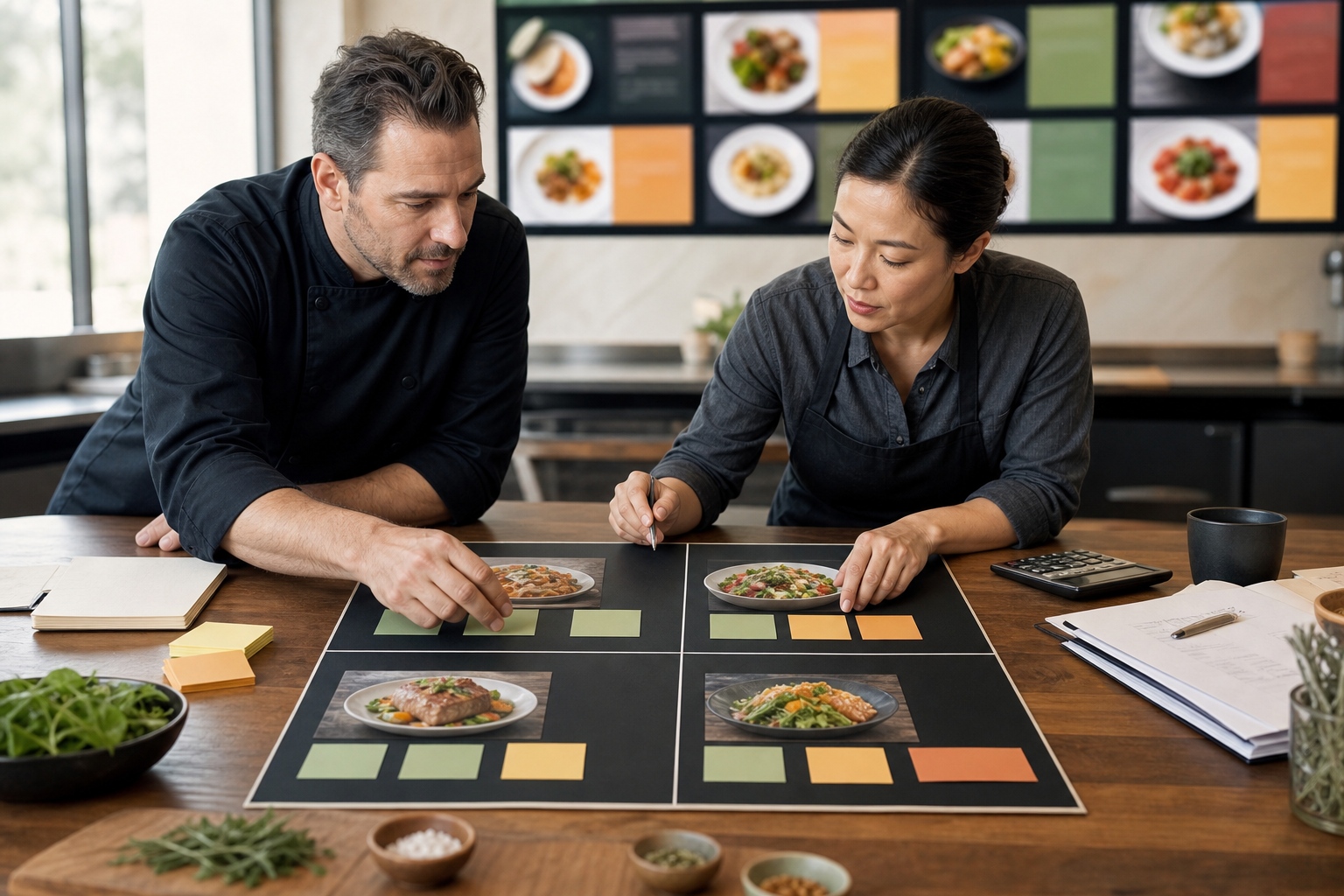
Current price pressure needs a better decision frame
The USDA July 2026 Food Price Outlook recorded continued movement in food-away-from-home prices and meaningful differences across food categories. The National Restaurant Association's July menu-price analysis reported that restaurant menu prices were rising more slowly than grocery prices during the first half of 2026. An Associated Press report on lettuce prices and supply disruption illustrates how one ingredient can simultaneously affect cost, availability, and guest demand.
The operational response should not be a blanket price increase or a board full of temporary badges. Start by assigning each item to a decision cell that reflects its actual job.
Keep the approved menu source and operating context together through the ServingIntel Genesis platform.
Build the four cells
- Anchor: familiar, high-demand items that establish value and make the menu easy to enter.
- Builder: items with healthy contribution and reliable execution that deserve clear visibility.
- Opportunity: profitable but under-selected items that may need a better name, image, placement, or staff cue.
- Watch: items with weak contribution, volatile supply, slow preparation, or frequent substitutions.
This is an editorial framework, not a claim about universal thresholds. Define the measures locally: units sold, contribution after ingredient cost, waste, preparation time, stockouts, and guest complaints.
Choose one action per item
For each item, choose one primary action: hold, reposition, clarify, bundle, test, simplify, pause, or retire. Avoid changing price, name, image, location, and bundle simultaneously because the result becomes impossible to interpret.
Coordinate web-menu releases with the POS Websites menu-price update playbook. Keep broader operating decisions connected through ServingIntel News & Insights.
Design for value recognition
A value message should help a guest compare choices without forcing them to decode visual noise. Use stable category order, readable price relationships, concise descriptions, honest portion cues, and limited emphasis. Do not hide mandatory charges or make the least expensive path difficult to locate.
Review screen placement and fleet constraints through ServingIntel hardware planning.
Run a seven-day controlled test
- Freeze the approved baseline and record every displayed endpoint.
- Change one decision variable for a defined location or service period.
- Track mix, contribution, stockouts, waste, substitutions, and complaints.
- Compare like-for-like service periods rather than a single busy hour.
- Keep, revise, or roll back the change with a named owner.
Use the five-screen price consistency audit before judging results; a mismatched endpoint can invalidate the test.
Document the next review trigger
Schedule a new review when supplier cost crosses the agreed threshold, availability changes, preparation time moves materially, or the mix shifts outside its expected range. The goal is a controlled learning loop, not constant menu churn.
Connect the decision to wider operating workflows through ServingIntel solutions.
The bottom line: a menu board protects margin and guest trust when every item has a defined role, every change tests one hypothesis, and every screen shows the same approved result.